For readers of The First Price by Kajal Deepak
The book's method now runs in your browser
The worksheet and templates help founders and entrepreneurs apply the book's principles to their own product, one decision at a time.
The worksheet is free and needs no sign-up. New to the book? Read about it below.
Why use the templates?
Think of the templates and the assistant as a lightweight consultant who walks you through each decision, for a fraction of a consultant's fee.
-
The templates apply the book's method to your product
Each template carries the book's formulas, checked against its worked example, so your time goes into your own numbers.
-
You get a consultant's structure for every decision
The assistant asks the questions a consultant would ask, flags what you may have missed and leaves every decision with you.
-
Early products get enough structure and rigor
The exercises are built to take an early product to a first price you can defend. A larger or more complex pricing project may still call for a consultant, and your saved work gives one a head start.
What can you do here?
The site turns the book's worksheets and formulas into tools you fill in for your own product, from the first question to the price you say out loud.
-
Free
You answer the eleven questions in order
The First Price Worksheet from Appendix A takes you through every pricing decision, and nothing you type leaves your browser.
-
With a pass
You work each decision in a template
The fourteen templates turn the book's worksheets into calculators and checklists, each checked against the book's worked example.
-
With a pass
The assistant thinks it through with you
It walks you through each template, checks what you might have missed and explains every number, and you accept each change.
-
With a pass
Your work stays saved and exportable
Your workspace keeps your answers for the 12 months of your pass, and you can export every template as a PDF or CSV file.
How does the assistant work with you?
You can open the assistant from any line, section or number in a template, and it starts from the spot you opened it on.
It walks you through the template
It asks one question at a time and builds the template with you from your answers.
It checks what you might have missed
It compares your entries with the chapter's checklist and flags gaps, such as your own time.
It explains any number
It shows the arithmetic behind a result and the chapter the formula comes from.
It tests your assumptions
It reruns your numbers at pessimistic and optimistic values and names the input your price depends on most.
Every suggestion names its chapter, every estimate is labeled as one, and your template changes only when you accept. The assistant gives no legal, tax, accounting or financial advice.
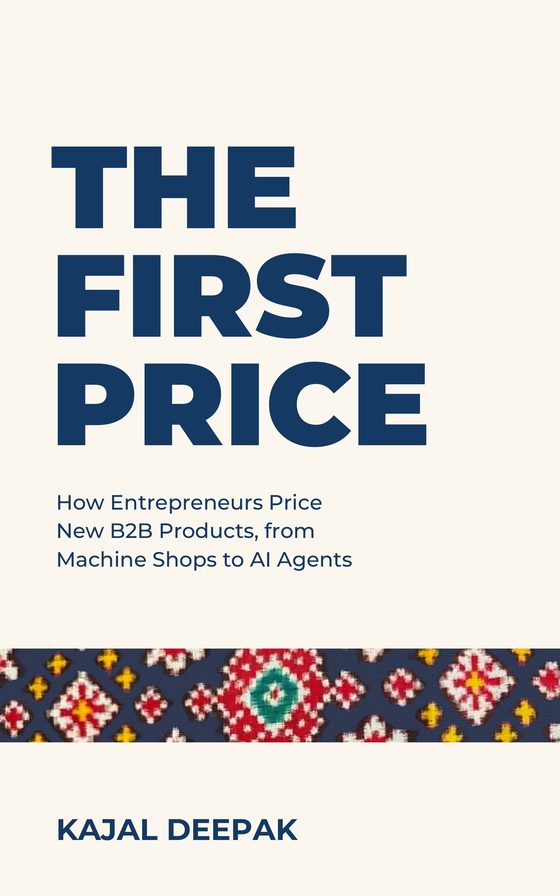
The book behind the tools
The First Price
How Entrepreneurs Price New B2B Products, from Machine Shops to AI Agents
Someone is about to ask what it costs. Have an answer you chose.
Most pricing advice assumes a product that already has a price. A new product has no sales history, often no category, and a buyer who decides as a committee. Its first price is usually the number a founder says out loud on a call, and that number tends to stick.
Both editions go on sale on Amazon on 16 November 2026. The paperback's ISBN is 979-8-9984096-0-8.
Who is this book for?
It is written for founders, product managers, and pricing consultants who must name a price with no sales history behind it.
Each chapter closes with an executive summary and an action checklist, so the book also works as a course text.
Every price hides five decisions
The book separates them so you can make each one on purpose.
- The revenue model
- The pricing metric
- The price level
- The packaging
- The terms
What will you learn about pricing AI?
Mainframe licensing and cloud met the same metering problem by keeping the meter and building two layers above it. For AI, that structure becomes a platform fee, a workload package in your customer's own unit, and metered overage with a buyer-set cap.
- The token fails five of the seven tests a pricing metric must pass.
- Credits leave your buyer's bill as hard to forecast as tokens do.
- You can give an AI buyer a forecastable bill and a ceiling without lowering your price.
- You size each package from the spread of your customers' consumption.
- Pooling capacity across an account lets light users absorb heavy ones.
- Pricing below cost to win share needs a written end game.
What is inside the book?
The book runs in five parts, from what a founder must know first to managing a price for as long as the product exists. It opens with the Introduction and closes with a Conclusion and two appendices.
Part I
You must know five things before you price
- 1Your price decides five things simultaneously
- 2Your cost floor tells you less than you think
- 3A committee decides what your buyer will pay
- 4Your buyer will only defend a number they can calculate
- 5Segments only hold if a fence separates them
Part II
What you charge for outranks how much you charge
- 6Model, metric, and level are three different decisions
- 7You can choose from fourteen revenue models
- 8Questions to help narrow the field to two or three models
- 9Tests to help you decide whether a metric will hold
Part III
You set the number and then you defend it
- 10Your price needs an objective before it needs a number
- 11You choose a number inside a corridor
- 12Packaging turns one product into several offers
- 13You can test a price with twelve prospects
- 14Your realized price is the one that matters
- 15A physical product changes some things about your price
- 16Microsoft sold the same products under four pricing metrics
Part IV
AI obeys every pricing rule but breaks three conventions
- 17Structural breaks that change how you price AI
- 18The token pricing approach fails the metric tests
- 19Computing kept the meter and built two layers above it
- 20AI pricing has three layers
- 21You price an AI workload by measuring a distribution
- 22Your cost per delivered task may not fall at all
- 23Pricing will be indexed to something other than compute
Part V
You will manage the price for as long as the product exists
- 24Outcome pricing works only under five conditions
- 25You will raise prices later than you should
- 26Case studies of companies priced from the customer's economics
- 27Founders break their own pricing in twelve ways
From the Introduction
How does the book begin?
Every new business reaches the point where someone has to say a price out loud.
It usually happens on a call, right after the prospect says the words every founder waits to hear. This is interesting. What does it cost? The founder has typically spent nine months on the product and about nine minutes on the price, so she answers with something, often phrased as a question. Sometimes it is a number she has never said before, which sounds absurd to her the moment she says it, and she discounts it before the prospect has responded.
That number then becomes the company's price without anyone deciding that it should. It goes into the follow-up email, and the next prospect gets the same number so the company looks consistent. Within eighteen months, forty customers are paying it, and changing it requires a project plan and a lawyer.
I wrote this book so that the first number you say out loud is one you chose.
Who wrote it?
Kajal Deepak owned Windows B2B pricing at Microsoft for four years, and later served as a General Manager at Amazon Web Services, where she launched and scaled AWS Audit Manager between 2020 and 2024 with full profit-and-loss and product responsibility. Many of the pricing decisions in this book are ones she has made and lived with.
Her career spans more than two decades of product and engineering leadership across AWS and Microsoft, including SQL Server, Windows, and Azure. She specializes in cloud security, compliance, and audit automation at enterprise scale, and she is a longstanding student of economics and pricing.
She is the founder of SmartVerify, which builds controls for how AI agents interact with enterprise data. Readers should note that interest when weighing the discussion of authority and evidence as pricing dimensions (Chapter 23).
Kajal holds an MBA from Harvard Business School, a B.Tech from IIT Delhi, and a CISSP certification.
What do readers ask?
Does the method work for products without AI?
The same fundamentals price any new product a business buys, from a specialty coating to a connected oven.
Does it help with a consumer product?
If you sell a consumer product, Part I and the channel arithmetic prepare you for the distributor or retailer deciding whether to carry it.
Are the companies in the case studies real?
The companies in the case studies and worked examples are illustrative.
What does the assistant run on?
It runs on Google's Gemini models through Google Cloud, and the privacy policy lists every service that handles your data.